How to Create Bulk 301 Redirects (Without Breaking SEO)
Bulk 301 redirects are used when large numbers of URLs need to be permanently redirected at once, rather than handled individually. They're most commonly required during website migrations, URL structure changes, CMS rebuilds, or when fixing hundreds of broken or outdated URLs across a site.
While the concept is simple, bulk redirects are also one of the easiest ways to introduce SEO issues at scale. Poor URL mapping, redirect chains, and unvalidated rules can quietly erode rankings, waste crawl budget, and disrupt internal linking without being immediately obvious.
This guide explains how to create bulk 301 redirects safely. It focuses on how bulk redirects are implemented in practice, where they commonly fail, and the workflows that allow large redirect sets to be applied, tested, and maintained without putting organic performance at risk.
What Are Bulk 301 Redirects?
Bulk 301 redirects are permanent redirects applied to large groups of URLs at the same time, rather than created one by one. Instead of manually defining each redirect, URLs are typically mapped in bulk using spreadsheets, pattern-based rules, or automated systems. Each redirect signals to search engines that a page has moved permanently and that ranking signals should be consolidated at the new destination.
The "bulk" aspect is what changes the risk profile. When managed correctly, bulk redirects allow large-scale site changes to be executed efficiently while preserving rankings, crawl efficiency, and user experience. With individual redirects, mistakes are usually isolated. However, in bulk implementations, a single error can affect hundreds or thousands of URLs at once. Incorrect mappings, overly broad rules, or untested redirect files can quickly introduce redirect chains, loops, or irrelevant destinations that negatively impact crawling, indexing, and rankings.
A simple bulk redirect mapping might look like this:
| Current Path | New Path |
|---|---|
| /old-page-url | /new-page-url |
| /blog/2023/article | /blog/2024/article |
| /products/item-123 | /products/item-456 |
When handled correctly, bulk 301 redirects preserve traffic and authority at scale. When handled poorly, they create technical debt that is often difficult to diagnose after the fact.
When Do You Need to Create Redirects in Bulk?
Bulk redirects are typically required when changes affect a large portion of a website, making individual redirect management impractical or risky.
Website Migrations
During migrations, URLs often change due to platform upgrades, redesigns, or structural improvements. Bulk redirects are essential to preserve rankings and ensure users and search engines are sent to the correct new locations.
URL Structure Changes
Changes to categories, slugs, or internal hierarchies can impact hundreds of URLs at once. Applying redirects in bulk ensures consistency and reduces the risk of missing individual pages.
Fixing 404 Errors
Larger sites frequently accumulate broken URLs from deleted content, expired campaigns, or legacy links. Bulk redirects allow these issues to be resolved efficiently rather than patched one by one.
CMS or Domain Changes
Moving between content management systems or changing domains often results in widespread URL differences. Bulk redirect workflows make it possible to map old URLs to their new equivalents without losing visibility or link equity.
In each of these cases, scale is the deciding factor. Once changes extend beyond a small set of pages, bulk redirect management becomes the safest and most reliable approach.
How Bulk 301 Redirects Are Implemented
Bulk 301 redirects are typically implemented using one of three approaches. Each method has different trade-offs in terms of control, scalability, and SEO risk.
CSV-Based Uploads
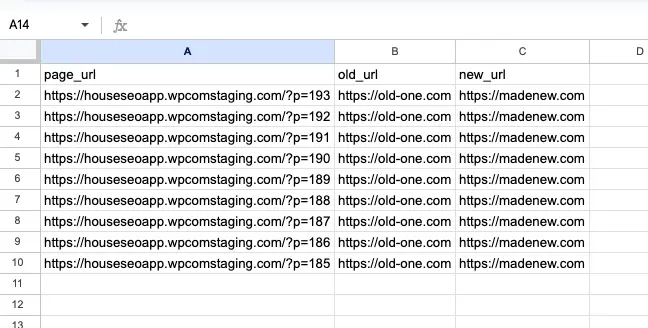
CSV-based uploads involve mapping old URLs to new URLs in a spreadsheet and uploading the file into a CMS, plugin, CDN, or redirect tool. This approach provides clear visibility and precise control over individual redirects, making it common for migrations and clean-up projects. The main risk is human error at scale, such as incorrect mappings, formatting issues, or duplicate entries that go unnoticed without validation.
Rule-Based or Pattern Redirects
Rule-based redirects use patterns or regular expressions to redirect groups of URLs dynamically. They are fast to implement and efficient when URL structures follow consistent rules. However, overly broad patterns can unintentionally redirect unrelated URLs, create redirect chains, or send users to incorrect destinations if not carefully tested.
API-Driven Redirects
API-driven redirects allow redirects to be created, updated, and managed programmatically. This method is well suited for large or frequently changing sites where automation is required. While highly scalable, API-based implementations introduce additional complexity and require safeguards to prevent misconfigurations from propagating across large redirect sets.
Each method can work effectively, but as redirect volumes increase, validation and monitoring become increasingly important.
How Bulk 301 Redirects Can Break SEO
Bulk 301 redirects fail most often not because the redirect itself is incorrect, but because small mistakes are multiplied across large sets of URLs. When issues occur at scale, their impact on crawling, indexing, and rankings is amplified and often delayed.
Redirect chains: Chains commonly occur when new redirects are layered on top of existing ones without auditing what is already in place. A single bulk update can unintentionally send URLs through multiple hops, increasing crawl time and weakening signal transfer.
Redirect loops: Loops typically arise when rules or bulk mappings conflict. In large redirect sets, it is easy to create circular paths where URLs point back to themselves or to another URL that redirects in return, preventing pages from being crawled or indexed.
Irrelevant target URLs: At scale, redirects are often mapped using patterns or assumptions rather than page-level intent. This can result in many URLs being redirected to loosely related or generic destinations, reducing relevance signals and creating poor user experiences.
Soft 404s: Bulk redirects that send users to thin, unrelated, or non-equivalent pages may be interpreted by search engines as soft 404s. While the redirect technically exists, the lack of meaningful content matches causes visibility to erode over time.
Crawl budget waste: Large redirect sets increase the number of URLs search engines must process. Without careful control, bots spend time crawling unnecessary redirect hops instead of discovering and indexing important pages.
An SEO-Safe Workflow for Bulk 301 Redirects
Creating bulk 301 redirects safely requires a structured workflow. Treating redirects as a one-time task rather than a managed system is where most large-scale problems originate.
- Map URLs intentionally: Every bulk redirect should begin with deliberate URL mapping. Old URLs need to be matched to the most relevant new destination, not simply the closest structural equivalent. This is especially important when consolidating content or restructuring navigation.
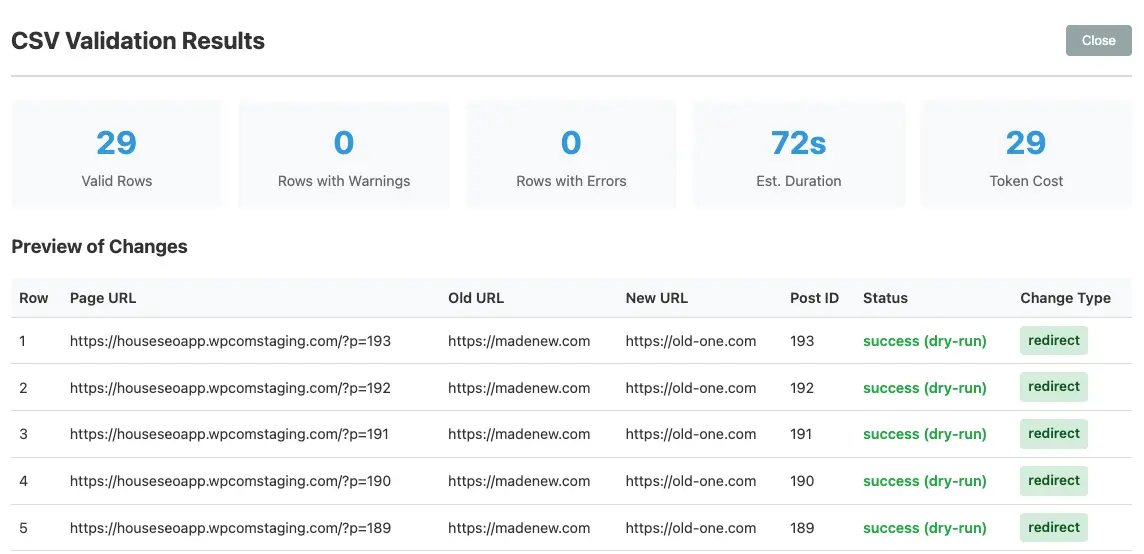
- Validate before deployment: Before any redirects go live, mappings should be checked for formatting errors, missing targets, duplicates, conflicts with existing redirects, and unintended pattern matches. Pre-deployment validation prevents small mistakes from affecting hundreds of URLs at once.
- Implement with rollback in mind: Once validated, redirects can be deployed using the chosen method. Where possible, changes should be versioned or staged to allow for rollback if unexpected issues arise.
- Test after launch: After deployment, redirects should be tested to confirm correct status codes, destination URLs, and redirect depth. Sampling across the full dataset is essential, as checking only a few URLs can miss systemic problems.
- Monitor continuously: Bulk redirects are not set-and-forget. Ongoing monitoring helps identify new chains, broken targets, or crawl anomalies introduced by future site changes. Redirects should be treated as a maintained asset rather than a temporary fix.
Implementing Bulk 301 Redirects at Scale
Once redirect volumes move beyond a few dozen URLs, manual approaches start to break down. Spreadsheets become harder to validate, existing redirects are easier to overlook, and small errors are more likely to propagate across large parts of a site. At scale, tooling matters less for convenience and more for control, validation, and long-term maintainability.
One way to implement bulk 301 redirects safely is by using a system designed specifically for managing redirects as a structured workflow rather than a one-off task. Krawl is one such implementation, built around bulk URL handling with SEO safeguards in place.
In practice, the process mirrors the workflow above:
- CSV upload – Redirects are mapped in a structured file that can be reviewed before deployment.
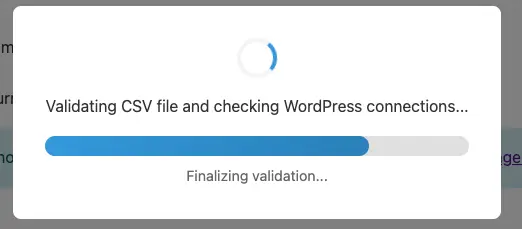
- Validation – Uploaded redirects are checked for missing targets, duplicates, formatting issues, and conflicts with existing rules.
- Deployment – Once validated, redirects are applied in bulk in a consistent, auditable manner.
For a practical example of this workflow, see the Bulk Redirect URLs tool.
Bulk Redirect Tools vs Plugins vs Systems
There are several ways to manage bulk 301 redirects, and the right approach depends on site size, team structure, and how frequently URLs change.
Plugins: Plugins are often the starting point for CMS-driven sites. They are easy to install and work well for small to moderate redirect sets. As volumes grow, however, plugins can become difficult to audit and maintain, particularly when redirects are spread across multiple configurations.
CDNs: CDNs handle bulk redirects efficiently at the edge and are well suited for pattern-based rules or high-traffic environments. While performant, they are typically less SEO-aware and can make auditing, relevance checks, and long-term governance more complex.
SEO-focused systems: Systems designed for SEO workflows treat redirects as part of a broader technical process. They prioritise validation, relevance, monitoring, and change control alongside bulk implementation, making them better suited for large sites and ongoing change.
As redirect volumes increase, the decision shifts from how quickly redirects can be created to how safely they can be managed.
Common Questions About Bulk 301 Redirects
How many redirects are too many?
There is no fixed limit on the number of 301 redirects a site can have. The primary concern is quality. Large sites can manage tens of thousands of redirects successfully when they are direct, relevant, and free of chains or loops.
Do bulk redirects slow sites down?
Properly implemented 301 redirects have minimal performance impact. Problems arise when redirects are chained, processed inefficiently, or managed across multiple systems.
How long should 301 redirects stay live?
In most cases, 301 redirects should remain in place for at least 12 months. For high-value or frequently linked URLs, keeping redirects indefinitely is often the safer option.
Final Thoughts
Bulk 301 redirects are one of the most effective tools for preserving traffic and authority during large-scale site changes, but they also carry more risk than individual redirects. When implemented without structure or validation, small mistakes can quickly scale into broader SEO issues.
Approaching bulk redirects as a controlled workflow rather than a one-off task helps balance that risk with the reward. Clear URL mapping, proper validation, testing, and ongoing monitoring allow redirects to be applied at scale without compromising search performance.
If you are looking to implement bulk redirects using an SEO-focused workflow, the Bulk Redirect URLs tool provides a practical way to manage large redirect sets with validation and control built in.
Ready to Implement Bulk Redirects?
Get started with our Bulk Redirect URLs tool and manage your redirects safely at scale.
 LinkedIn